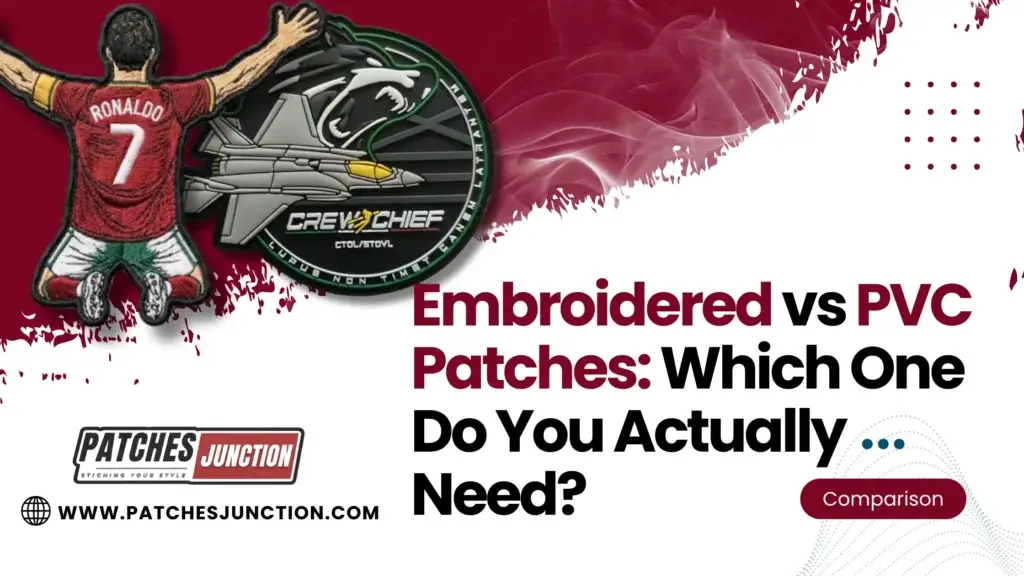
If you’re ordering custom patches and you’ve narrowed it down to embroidered or PVC, you’re already asking the right question. These two materials account for the vast majority of custom patches produced today, and they’re genuinely different in how they’re made, how they perform under pressure, and what they cost.
Neither is universally better. This guide breaks down the real differences across durability, design capability, aesthetics, backing, maintenance, and pricing so you can make a confident decision based on your specific application rather than guesswork.
How Each Type Is Made
Understanding the production process behind each material makes every other comparison easier to follow.
Embroidered Patches
Embroidered patches are produced by stitching colored thread onto a fabric base, typically twill or felt. The artwork is converted into a digital stitch file through a process called embroidery digitizing, then sewn by machine according to that file.
Thread coverage is one of the most important variables in the process. It refers to how much of the fabric backing is hidden beneath stitching, and it typically ranges from around 50% to 100%.
- 50% coverage leaves visible fabric texture between stitches, producing a lighter feel and lower stitch count
- 75% coverage is a common middle ground that balances density, appearance, and cost
- 100% coverage means the entire patch surface is stitched, creating the richest texture and most premium appearance at higher production complexity
Higher coverage increases the stitch count, raises production time, and affects pricing. It also influences how fine design elements hold up and how the patch looks both up close and at a distance.
Standard thread is the backbone of most designs, but specialty thread options open up interesting possibilities: metallic gold and silver thread for a refined finish, reflective thread for visibility in low-light conditions, neon and high-brightness thread for bold visual impact, and photoluminescent thread that glows after exposure to light. These aren’t niche options — they’re genuinely useful tools for the right project.
PVC Patches
PVC patches are molded from polyvinyl chloride rather than stitched from thread. Liquid PVC is poured into molds and cured under heat, with colors built up in layers to match the design. The finished material has a flexible, rubber-like quality, which is why these are often called PVC rubber patches in the industry.
The two main formats are 2D and 3D PVC patches.
- 2D PVC patches present design elements at a relatively consistent height, delivering clean graphic definition without significant dimensional depth
- 3D PVC patches use raised and recessed sections to create physical dimension, where certain design elements literally stand above others
Both formats can incorporate glow-in-the-dark details, reflective elements, and layered color construction. PVC patches became a go-to material for military and tactical applications because of how well they hold up in harsh environments, but their use has expanded well beyond that origin.
Durability and Weather Resistance
This is often the factor that tips the decision, particularly for buyers sourcing patches for outdoor gear, tactical equipment, or uniforms that see real use.
PVC generally performs better in demanding conditions. Because there’s no thread involved, there’s nothing to fray. Rain, snow, mud, and humidity don’t penetrate or weaken the material the way they can with embroidery over time. PVC patches handle repeated wet exposure, rough handling, and dirty field conditions without significant deterioration. UV resistance is generally solid as well, though years of intense direct sunlight will affect most patch materials to some degree.
Quality embroidered patches, however, are not fragile. Millions of embroidered uniform patches, sports patches, and achievement badges have lasted for years of regular use. The real distinction is the environment they’re asked to perform in.
Embroidery holds up well in moderate conditions:
- Corporate uniforms and business apparel
- Sports jerseys, caps, and team gear
- School, club, and achievement patches
- Fashion and lifestyle clothing
- Indoor or controlled-environment applications
Where embroidery becomes more vulnerable is in genuinely harsh conditions. Prolonged moisture exposure can affect thread integrity over time. Repeated washing with aggressive detergents gradually degrades thread quality and can introduce fraying at patch edges. Heavy UV exposure and consistent heat accelerate color fading. These factors don’t disqualify embroidery from the conversation, but they’re worth understanding before committing to a material for outdoor or heavy-use gear.
The practical takeaway: if patches will face constant moisture, mud, or rugged outdoor conditions, PVC is the safer material choice. For most apparel and moderate-use applications, well-made custom embroidered patches hold up without issue.
Design Capabilities: What Each Material Can and Can’t Do
This is where the two materials diverge most clearly in practical terms.
Embroidery excels at bold, classic graphic work. Thick outlines, large lettering, strong color blocks, and traditional badge-style designs are exactly what the format was built for. The raised texture and visible stitch structure add dimension that works beautifully for heritage aesthetics, corporate logo patches, sports team designs, and any application where a handcrafted quality is part of the appeal.
The limitation is fine detail. Thread has physical thickness, and stitches take up space. Very thin lines, tiny text, subtle gradients, and highly complex small-scale graphics become difficult to reproduce cleanly in embroidery. The practical limits depend on the overall patch size, the artwork, the thread gauge, and the stitch density in use. A good manufacturer can advise on what will reproduce clearly at a given size, but the general principle holds: if your design has intricate small elements, embroidery often requires some simplification to look sharp.
PVC handles fine detail more reliably. Because the design is molded rather than stitched, edges are crisp, lines stay clean, and small elements can be reproduced with more precision. Strong color separation, layered depth, and sharp graphic definition are native strengths of the format.
PVC is particularly well-suited to:
- Modern logos with tight line work and clean geometry
- Small lettering and fine elements that need to stay legible
- 3D dimensional effects where physical depth adds visual impact
- Bold, graphic-heavy designs with strong contrast and color separation
That said, PVC has its own constraints. Color gradients and photorealistic detail that rely on subtle tonal blending don’t translate well to molded construction. The material works best with designs that have defined, separated color areas. If you want to explore what works well in PVC artwork specifically, Patches Junction’s PVC patch design guide covers the key artwork preparation considerations in depth.
Aesthetics and What Your Patch Communicates
Material choice affects more than performance. It shapes how the finished patch is perceived.
Embroidered patches carry a traditional, handcrafted character. The visible thread texture, the slightly raised stitched surface, and the classic construction signal quality and intention. This is why embroidery dominates fashion branding, heritage apparel, luxury streetwear, varsity jackets, and any application where the patch should feel refined and permanent.
PVC patches read differently. They feel modern, tactical, and technical. The clean molded surface, dimensional layering, and rubber-like feel align naturally with gear-oriented and performance-focused aesthetics. The military, law enforcement, and outdoor equipment markets adopted PVC so readily because the material looks and feels like it belongs on that kind of gear.
Neither is objectively superior in visual terms. The right choice depends entirely on what the patch needs to communicate about the brand, unit, or organization it represents.
Backing Options: Both Materials, Full Flexibility
Backing is a separate decision from patch material, and both embroidered and PVC patches support the same core options.
- Sew-on backing provides the most durable long-term attachment and works well on applications that won’t need to be removed
- Iron-on (heat seal) backing uses a heat-activated adhesive that bonds directly to fabric during application
- Velcro (hook and loop) backing allows patches to be swapped quickly and easily between garments or gear
- Adhesive (peel-and-stick) backing suits temporary applications or situations where sewing or heat isn’t practical
Velcro backing deserves particular attention for military, law enforcement, tactical, and firefighter applications. The ability to quickly swap patches between carriers, uniforms, and gear makes hook-and-loop the standard in those environments. Morale patches, unit identifiers, and rank insignia all benefit from this interchangeability, which is one reason why custom military patches and custom PVC patches are so often paired with Velcro.
For a full breakdown of attachment methods and which works best for different applications, the patch backing guide on Patches Junction’s blog covers each option in detail.
Care and Maintenance
Day-to-day maintenance differs meaningfully between the two materials, and it’s worth knowing before you commit.
For embroidered patches, proper care extends the lifespan considerably:
- Turn garments inside out before washing to reduce friction against the stitched surface
- Use cold water and a gentle cycle rather than aggressive settings
- Avoid harsh detergents, bleach, and fabric softeners that accelerate thread degradation
- Air dry when possible; if using a dryer, keep the heat low
- Hand washing is the safest approach for patches with specialty threads or delicate coverage
Quality embroidery thread is colorfast under normal conditions, but cumulative exposure to heat, chemicals, and direct sunlight does add up over time and affects long-term appearance.
PVC maintenance is more straightforward. A damp cloth handles most cleaning. The material doesn’t absorb moisture, doesn’t fray, and tolerates field conditions without special handling procedures. For gear that gets genuinely dirty, PVC patches simply require far less attention than their embroidered counterparts.
Patches Junction’s patch care and maintenance guide covers both material types in more practical depth, including specific recommendations for different environments.
Cost and Long-Term Value
Embroidered patches are generally less expensive to produce, particularly at lower quantities. The production process is well-established, and pricing scales efficiently with order volume. Key cost drivers include patch size, stitch count, number of thread colors, coverage level, and backing type.
PVC patches typically carry higher upfront costs. Mold creation is a one-time setup expense with no equivalent in embroidery production, and the molding process is more involved in terms of labor and materials. Design complexity, dimensional construction, and material costs contribute to per-unit pricing that tends to run higher, especially at lower quantities.
Both materials benefit significantly from bulk ordering. The per-unit price drops as quantities increase, and the mold cost for PVC becomes proportionally smaller when spread across a larger run.
It’s worth resisting the instinct to simply pick the cheaper option. A PVC patch that holds up for years on outdoor gear with minimal maintenance may represent stronger total value than a less expensive embroidered patch that degrades in the same environment. Conversely, spending more on PVC for patches that will live on retail apparel and rarely see rain is likely unnecessary. The right material for the application is almost always the better value in the long run.
Choosing Based on Your Application
Here’s the practical version of the embroidery patch comparison.
Embroidered patches generally make more sense for:
- Fashion and lifestyle brands, streetwear, and retail apparel
- Denim jackets, hoodies, caps, and fashion-forward clothing
- Corporate uniforms, polo shirts, and professional apparel
- School, club, and achievement patches
- Sports teams, jerseys, and athletic gear
- Heritage, vintage, and classic-aesthetic branding
- Any application where traditional craftsmanship is part of the visual identity
PVC patches are typically the better choice for:
- Military gear and tactical equipment
- Law enforcement and firefighter uniforms and gear
- Outdoor apparel, adventure equipment, and survival gear
- Motorcycle and motorsport applications
- Search and rescue, construction, and industrial workwear
- Morale patches and interchangeable gear identification
- Any application where moisture, mud, or rugged conditions are routine
Custom sports patches, corporate branding patches, and promotional patches can genuinely work well in either material depending on the design and the environment the patches will live in. There’s real overlap in those categories.
At Patches Junction, the team walks through these decisions based on the actual artwork, intended application, expected conditions, and order quantities. The goal is always to match the material to the use case rather than defaulting to one format for everyone.
A Brief Note on Environmental Considerations
PVC is a synthetic plastic, and it’s worth acknowledging the environmental dimension of that honestly. The impact of PVC patches depends on factors like manufacturing practices, the lifespan of the product, how it’s disposed of, and whether recycling options exist.
A well-made PVC patch that lasts for a decade on a piece of gear has a different environmental profile than one that’s discarded quickly. Some manufacturers are developing alternative materials and more sustainable production approaches, and the industry is slowly moving in that direction. If environmental considerations are a priority for your organization, it’s worth asking your manufacturer directly about available options.
Frequently Asked Questions
Are PVC patches better than embroidered patches? Neither is universally better. PVC outperforms embroidery in demanding outdoor and moisture-heavy environments. Embroidered patches are the right choice for most apparel, fashion, and moderate-use applications. Better means different things depending on the environment and the application.
Which lasts longer, PVC or embroidered patches? In harsh outdoor conditions involving moisture, mud, and heavy use, PVC tends to last longer. In standard clothing and uniform applications, quality embroidered patches hold up for years with proper care. Both are durable when matched to the right environment.
Can PVC patches be ironed on? PVC patches are generally not compatible with iron-on application because high heat can damage the PVC material. Velcro or sew-on backing is the standard recommendation for PVC patch attachment.
Do embroidered patches fray? Poorly made embroidered patches can fray at the edges, particularly with repeated washing or rough handling. Well-manufactured patches with quality merrowed borders or heat-cut edges are significantly more resistant to fraying. Proper care also plays a meaningful role.
Are PVC patches waterproof? PVC patches have strong moisture resistance and handle wet conditions well. The material doesn’t absorb water and doesn’t fray when wet. Whether a patch system is fully waterproof also depends on the attachment method and the garment or gear it’s attached to.
Are embroidered patches cheaper than PVC patches? Generally, yes. Embroidered patches tend to be less expensive, particularly at lower quantities. PVC involves mold creation and a more complex production setup that increases upfront costs. Both materials offer better per-unit pricing as order quantities increase.
Which patch type is better for military or tactical gear? PVC is the standard in military, law enforcement, and tactical applications because it handles outdoor conditions, moisture, and heavy use without fraying or deteriorating. Velcro-backed custom military patches and tactical patches are produced almost universally in PVC for these reasons.
Can the same design work in both materials? Often, but results vary. Bold graphics, thick outlines, and strong color blocks translate well to both formats. Very fine detail and complex small-scale elements may require design adaptation for embroidery to reproduce cleanly. A manufacturer can advise on how a specific piece of artwork will render in each format before you commit.
Patches Junction produces both custom embroidered patches and custom PVC patches across a full range of backing options, sizes, and applications. If you’re working through the decision between materials, their team can review your artwork and intended use to recommend the right direction before you place an order.

About the Author
Meet Charlotte Rochefort, Custom Patch Specialist & Production Manager at Patches Junction. With over 15 years of experience, she’s the expert behind creating high-quality custom patches for a wide range of industries Read More