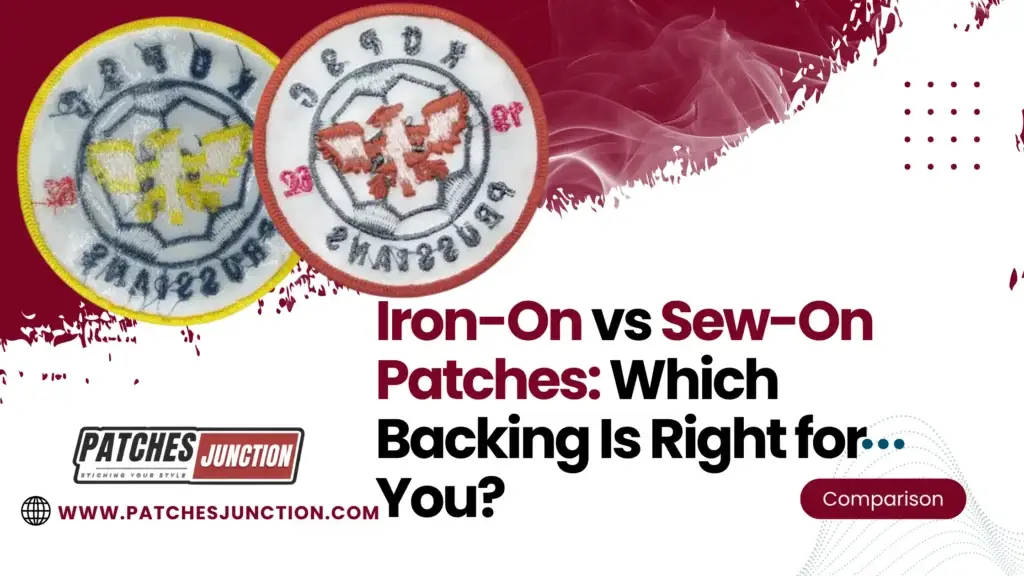
Iron-on patches are the better choice for cotton and denim when the garment doesn’t get washed much. Sew-on is what you want for uniforms, workwear, and anything going through the laundry every week.
Three things decide it: the fabric, how often it gets washed, and how long the patch needs to stay on. Everything else is detail.
We see the same pattern constantly. Someone spends three weeks going back and forth on artwork, gets the colours exactly right, approves the proof, and then picks the backing in about ten seconds because it feels like a small detail. Four washes later the corners are curling and they’re asking what went wrong.
Backing isn’t a small detail.
Need all the options? This guide only covers iron-on and sew-on. Hook-and-loop, adhesive, and everything else is in our Complete Patch Backing Guide.
How Iron-On and Sew-On Patch Backing Works
Iron-on has a layer of heat-activated adhesive on the back. Heat melts it, pressure pushes it into the fabric, and it sets as it cools. That’s the whole mechanism.
Sew-on has nothing on the back at all. Just the patch. You attach it with thread.
That one difference drives everything else:
- Iron-on bonds chemically — adhesive gripping fabric fibres
- Sew-on holds mechanically — thread passing through both layers
Which Fabrics Suit Iron-On Patches and Which Need Sew-On
This is the step people skip, and it’s the one that eliminates an option outright more often than anything else.
Take iron-on well: cotton, denim, canvas, cotton-heavy blends. These handle the heat and the weave gives adhesive something to grip. Cotton runs around 380 to 400°F, blends closer to 350 to 380°F.
Need sew-on instead: nylon, polyester, leather, waterproof and coated fabrics, stretch material.
Nylon melts at those temperatures. Not “might get damaged” — melts. Leather scorches and the damage doesn’t come out. Waterproof fabrics have coatings specifically designed so things don’t stick to them, which defeats the entire purpose of an adhesive.
Sew-on has none of these limits. Thread works on all of it because there’s no heat involved.
Read the care label. If it says low heat or no iron, that’s your answer already.
Full fabric breakdown for every backing type is in our Complete Patch Backing Guide.
Application Effort: Iron-On vs Sew-On Patches
The gap here is wide, and it’s the strongest argument iron-on has:
- Iron-on: under five minutes, no skill needed, household iron is the only tool
- Hand sewing: 15 to 20 minutes per patch, basic stitching ability required
- Machine sewing: two to three minutes, but you need the machine and some practice
Iron-on wins this one outright. No argument.
What it doesn’t win is what happens after. For a fifty-person uniform order, most people still end up paying a tailor, because the durability is worth the labour. Step-by-step instructions for both methods are in our Complete Patch Backing Guide.
Durability: How Long Do Iron-On and Sew-On Patches Last?
Here’s where it flips.
Iron-on adhesive breaks down with every wash. Corners go first, always — that’s where the patch flexes when you move and where it catches on things in the machine. The middle usually holds long after the edges have let go. Typical range is 10 to 25 wash cycles at home. Cold water and air drying push it higher. Hot water and a hot dryer will get you to the low end fast.
Sew-on doesn’t work that way. Thread doesn’t dissolve in detergent. Stitched properly, patches go past 100 washes without any issue.
This is why commercial laundering settles the question by itself. Restaurants washing chef coats every night, fire departments cleaning turnout gear, security companies running uniforms through industrial machines weekly — all sew-on. Iron-on doesn’t survive that for a month.
What pushes iron-on toward the high end of that range:
- Cold water and air drying instead of a hot dryer
- Cotton or denim rather than synthetics
- Turning the garment inside out before washing
But if the garment gets washed twice a year, none of this matters much. A decorative patch on a jacket you wear occasionally will hold on adhesive for years. Washing frequency is the variable here, not the backing on its own.
How Iron-On and Sew-On Patches Look on a Finished Garment
Iron-on sits flat with no visible stitching. Clean edge, nothing interrupting it. Good for fashion pieces and casual wear where you want the patch to look like it belongs to the garment.
Sew-on shows thread around the border. On a work jacket, a scout sash, or a uniform, that’s not a downside — stitching reads as proper and deliberate. It’s the look most people actually want on those items.
Worth knowing is how each one ages:
- Iron-on gets uglier as it fails — curled corners make good artwork look cheap
- Sew-on either holds, or shows a broken stitch you can fix in two minutes
The Hybrid Method: Iron-On Patches Reinforced With Sew-On Stitching
Nobody asks about this one, but it’s genuinely useful.
Iron the patch on first to lock the position, then stitch around the edge. The adhesive holds everything still while you sew, which fixes the most irritating part of hand-stitching — the patch sliding out of alignment halfway through.
You end up with adhesive underneath and stitching on top. Worth doing when:
- Placement has to be exact and you’re stitching anyway
- The garment sees heavy use and frequent washing
- You’re hand-sewing and want the patch to stay put while you work
Cost Comparison: Iron-On Patches vs Sew-On Patches
Iron-on backing adds a small amount per patch, and that’s the end of it. No installation labour, because whoever receives the patch applies it themselves.
Sew-on backing costs nothing extra on the patch itself. The cost sits in installation:
- Paying a tailor or alterations shop, priced per patch
- Bulk installation services, cheaper per patch on volume
- Doing it yourself, which costs time instead of money
Current pricing for each backing type is in our Complete Patch Backing Guide.
On paper iron-on looks cheaper, and for a one-off order it is. What flips it is replacement frequency. A hundred iron-on patches on weekly-washed uniforms need redoing within a season. A hundred sewn patches don’t. For anything going through commercial laundry, sew-on comes out cheaper by the end of the first year even after paying for installation.
When Neither Iron-On Nor Sew-On Works: Removable Patches
Neither one is built for this. Iron-on is meant to be permanent and taking it off can damage the fabric. Sew-on means unpicking stitches every single time.
That’s hook-and-loop territory:
- Rank insignia that changes with promotion
- Name patches on rental or shared uniforms
- Morale patches moving between carriers
Covered in our Complete Patch Backing Guide.
Should You Choose Iron-On or Sew-On Patches for Your Garment?
Go with iron-on patches when:
- The fabric is cotton, denim, canvas, or a cotton-heavy blend
- Whoever’s applying them doesn’t sew
- It’s decorative or casual wear
- The garment gets washed monthly or less
- You need it done fast
Go with sew-on patches when:
- It’s washed weekly or goes through commercial laundry
- It’s uniforms, workwear, or military patches
- The fabric is leather, nylon, synthetic, coated, or heat sensitive
- The patch is large, or it’s going on a cap or a curved bag
- It needs to last for years
Go hybrid when:
- Placement needs to be exact and you’re stitching anyway
- Heavy daily use and frequent washing
Common Iron-On and Sew-On Patch Mistakes to Avoid
On the iron-on side:
- Heat on nylon or coated outerwear — completely preventable, damage is instant
- Iron-on for uniforms heading to industrial laundry — fails every time
- Sliding the iron instead of pressing down — leaves edges that never bonded
On the sew-on side:
- Stitches spaced too far apart, so edges lift and start fraying at a corner
- Sewing a large patch onto fabric too light to carry it
- Leaving corners unreinforced, where most of the stress lands
The one that applies to both: ordering backing before you know what fabric it’s going on. That causes more problems than everything else combined. Pick the garment first.
Choosing Between Iron-On and Sew-On: Three Questions to Answer
It comes down to three things:
- What’s the fabric? Heat-safe or not
- How often is it washed? Weekly or twice a year
- How long does it need to hold? A season or a decade
Cotton, washed occasionally, decorative — iron-on is fine. Synthetic or heat-sensitive, washed constantly, uniform use — sew-on. Want the placement precision and the durability, use both.
Patches Junction makes custom embroidered patches with every backing option. Tell us the garment material, how often it’ll be washed, patch size and quantity, and we’ll confirm the backing before anything goes into production.
Getting it right costs nothing extra. Getting it wrong means buying the same patches twice.
Frequently Asked Questions
Which is better, iron-on or sew-on patches? Neither, across the board. Iron-on is better for quick DIY application on cotton and denim for casual use. Sew-on is better for uniforms, frequent washing, and heat-sensitive fabrics. The right answer depends on the fabric, how often the garment gets washed, and how long the patch needs to stay on.
Do sew-on patches last longer than iron-on patches? Usually yes. Iron-on typically lasts 10 to 25 wash cycles before the edges start lifting. Properly stitched sew-on patches go past 100 washes. The difference is that thread doesn’t weaken from detergent or dryer heat the way adhesive does.
Are iron-on patches permanent? They’re designed to be, but the bond weakens with repeated washing, dryer heat, stretching, and friction. Corners lift first, well before the centre lets go. How long it holds depends on the fabric, your washing habits, and how carefully it was applied.
Can I sew over an iron-on patch? Yes, and it’s a good idea for anything that’ll be washed often. Iron it on to hold the position, then stitch the edges. The adhesive stops the patch sliding around while you sew, and you end up with a more secure result than either method alone.
Can iron-on patches go in the washing machine? Yes, with care. Cold water, gentle detergent, air dry when you can. Turning the garment inside out helps too. Hot water and a hot dryer are what kill iron-on patches fastest.
Are iron-on patches good for denim? Denim is one of the best fabrics for it. It takes the heat well and the weave gives adhesive plenty to grip. Large patches on heavy denim jackets are worth reinforcing with corner stitches, but standard sizes hold well on their own.
Can you iron patches onto nylon? No. Nylon melts at the temperature iron-on adhesive needs, and it can also shine or distort permanently. Sew-on is the only safe option for nylon and most synthetic technical fabrics.
What backing is best for military and tactical patches? Sew-on for permanent identification on duty and dress uniforms. Hook-and-loop for tactical gear where patches move between carriers and assignments. Iron-on isn’t suitable for either.
Which backing works for sports team uniforms? Sew-on for game uniforms, since they’re washed after every use. Custom sports patches on fan merchandise or anything washed rarely work fine with iron-on.

About the Author
Meet Charlotte Rochefort, Custom Patch Specialist & Production Manager at Patches Junction. With over 15 years of experience, she’s the expert behind creating high-quality custom patches for a wide range of industries Read More