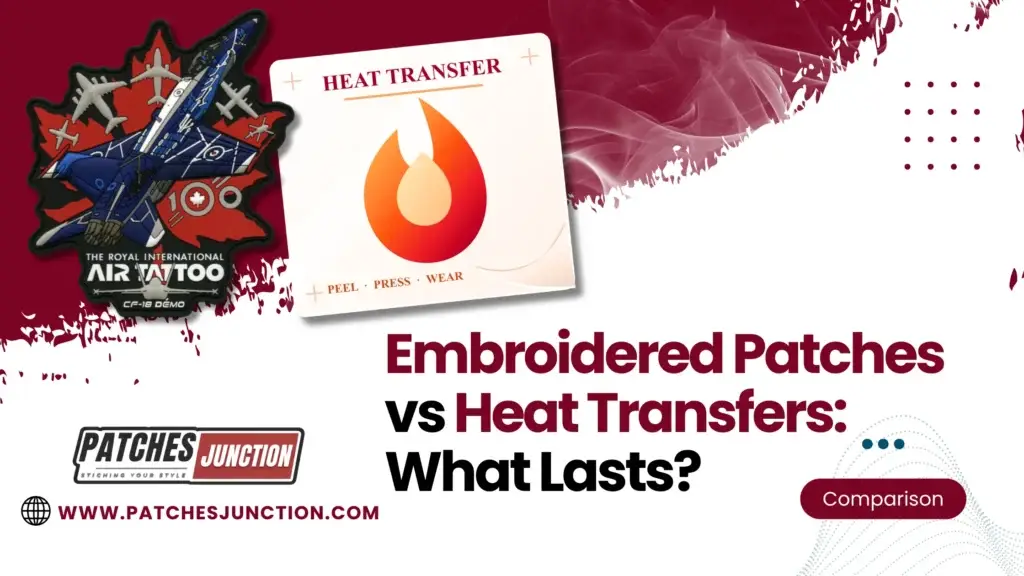
Embroidered patches last longer than heat transfers in almost every real-world scenario. A quality embroidered patch typically stays intact for five to ten years and often outlives the garment it’s attached to. Heat transfers vary widely by type: basic heat transfer vinyl usually starts lifting at the edges somewhere around 25 to 40 wash cycles, while a properly cured DTF transfer can push past 50.
Here’s what that looks like in practice. A fire department orders 40 station jackets. The embroidered chest patches are still legible after six years of shift work and industrial laundering. The vinyl-transferred unit name on the sleeve cracked across the middle in year two and had to be redone.
That gap exists for a structural reason. Embroidery is thread physically stitched through fabric. A heat transfer is a thin layer of vinyl, ink, or film bonded to the garment surface. One is built into the material. The other sits on top of it.
Longevity isn’t the only thing that matters, though. Transfers reproduce artwork embroidery genuinely can’t, they cost less at small quantities, and — this is the part most comparison guides skip — a large share of transfer failures come down to application error, not the method itself.
The Short Answer
- Longest lasting: Embroidered patches. Five to ten years typical, often outlasting the garment.
- Best for fine detail and full-color art: DTF or sublimation transfers.
- Cheapest at low quantity: Heat transfers, by a clear margin under about 50 pieces.
- Only option on leather, nylon, or coated fabric: Embroidered patches with sew-on backing.
- Lowest cost per wear over a multi-year uniform program: Embroidered patches, usually by a wide margin.
What Each Method Actually Is
The terminology gets muddled constantly, so it helps to be precise.
Embroidered patches
An embroidered patch is a separate piece of decoration made by stitching colored thread onto a fabric base, usually twill or felt. The artwork is converted into a stitch file through embroidery digitizing, then produced on an embroidery machine.
The finished patch is a standalone object, attached afterward using a backing: sew-on, iron-on, hook-and-loop, or adhesive. Because it exists independently of the garment, it can be moved, replaced, or applied to items that could never be embroidered directly.
Heat transfers
A heat transfer is artwork applied directly onto the garment surface using heat and pressure. There’s no separate physical piece.
Four distinct technologies fall under this label, and they don’t behave the same way:
- Heat transfer vinyl (HTV) — the design is cut from colored vinyl sheet and pressed onto the fabric. Limited to solid shapes and roughly one to three colors.
- Screen print transfers — plastisol ink is printed onto release paper and heat-applied. Quality ranges enormously between suppliers.
- DTF (direct-to-film) — full-color CMYK printed onto film with a powdered adhesive layer. The modern default for detailed artwork.
- Sublimation — dye bonds into polyester fibers rather than sitting on top. Cannot crack or peel, but only works on polyester and light-colored fabric.
That last distinction matters more than almost anything else in this comparison. Lumping sublimation and cheap HTV together as “heat transfers” produces bad decisions.
How Long Does Each Method Actually Last?
Durability is the core of the embroidered patches vs heat transfers question, and the honest answer is a range rather than a single number.
Embroidered patches: Five to ten years of regular wear is typical, and a sew-on patch on a work jacket will often outlast the jacket. Damage, when it happens, is usually edge fraying rather than design failure. Quality polyester embroidery thread is colorfast and holds color through repeated laundering.
Heat transfer vinyl: Commonly starts lifting at the edges around 25 to 40 home wash cycles, faster on large solid areas and high-flex zones.
Screen print transfers: Highly variable. Good plastisol transfers rival DTF; cheap ones fade and crack well before 25 washes.
DTF transfers: Properly cured, generally rated at 50-plus home washes. Some suppliers publish wash tests claiming 100 or more.
Sublimation: Won’t crack or peel at all, because the dye becomes part of the fiber. It fades slowly under UV exposure instead. Polyester only.
A note on where these numbers come from. The industry’s standard home-laundering durability test is AATCC TM135, which evaluates a decorated fabric over 25 laundering cycles; AATCC TM158 covers dry cleaning. Almost every published wash-durability figure for transfers, though, comes from the supplier selling the transfers, not an independent lab. Treat vendor claims of 100-plus washes as a best case under ideal application, not a guarantee. Ask any supplier which test method their number refers to — the ones who can answer are the ones worth buying from.
Why Transfers Fail — And Why It’s Often Not the Transfer’s Fault
This is the part most comparison articles get wrong, and it’s worth being fair about.
Two things break transfers. The first is mechanical: an adhesive layer and a printed surface flex every time the garment moves, and repeated flexing creates micro-cracks. Hot water and dryer heat soften the adhesive over time.
The second cause is application error, and in commercial complaints it’s the bigger one. Every transfer type has a specified press temperature, pressure, and dwell time. Deviate on any of the three and the adhesive bond is compromised before the garment is ever worn. DTF, for example, typically needs roughly 320–340°F for 15–20 seconds, plus a full cool-down before handling. Fold a shirt while the print is still warm and you’ve built in micro-cracks that show up eight washes later.
The practical implication cuts both ways. A well-applied DTF transfer from a shop that follows its parameters will outperform a badly applied one by a wide margin. But you’re depending on somebody else’s process control. An embroidered patch has no equivalent failure mode — the stitching either exists or it doesn’t, and you can see it in the sample.
Failure patterns by type:
- HTV — cracks and lifts at edges, worst on large solid fills
- Screen print transfers — fade and crack, quality varies widely
- DTF — outperforms basic HTV but still degrades with time and heat
- Sublimation — no cracking or peeling; UV fade only
The variables that shorten transfer lifespan are predictable: hot water washing, high dryer heat, ironing over the design, heavy stretching, and industrial laundering.
Where Heat Transfers Genuinely Win
Presenting embroidery as universally superior would be dishonest. Transfers solve problems embroidery can’t.
Fine detail and photographic artwork. Thread has physical thickness. Tiny text, hairline detail, and smooth gradients are difficult or impossible in embroidery. DTF and sublimation handle photographic images without issue.
Unlimited colors. Embroidery pricing is affected by thread color changes and stitch count. Full-color printed transfers cost the same at three colors or three hundred.
Weight and flexibility. Transfers add almost nothing to the garment, which matters for performance apparel and lightweight tees where a stiff patch would feel wrong.
Stretch fabrics. Embroidery on highly elastic material can pucker or distort. Quality transfers flex with the fabric.
Low quantities and fast turnaround. For a run of twenty shirts, transfers are cheaper and faster. No digitizing setup, no patch production step.
Large designs. A full-back graphic in embroidery carries an enormous stitch count and cost. As a transfer, size barely affects price.
Appearance and Perceived Value
The two look and feel completely different, and that difference carries real weight with customers.
Embroidered patches read as premium. The raised texture, visible stitch structure, and physical dimension signal deliberate craftsmanship, which is why embroidery dominates corporate uniforms, heritage brands, and varsity jackets.
Heat transfers look modern and graphic, but flat. Well-executed DTF work looks clean and professional. Cheap HTV on a promotional tee looks exactly like what it is.
There’s a practical retail consequence. An embroidered logo generally supports a higher price point than a printed one on comparable apparel. Customers register texture as quality even when they aren’t consciously evaluating it.
Fabric Compatibility
This factor rules out one option more often than people expect.
Embroidered patches work on nearly anything. Because the patch is made separately, the garment only needs to accept a backing. Sew-on backing works on leather, nylon, canvas, waxed cotton, and technical outerwear where direct decoration is impossible.
Heat transfers are more restricted:
- Sublimation only works on polyester and light colors
- Heat-sensitive synthetics can melt or scorch under a press
- Waterproof and coated fabrics often reject adhesive bonding
- Textured and ribbed fabrics prevent even contact
- Leather and faux leather generally can’t take press temperatures
If your garment is a leather jacket, a nylon shell, or a coated work uniform, embroidered patches are effectively the only option.
One Point of Confusion Worth Clearing Up
A patch applied with heat is not a heat transfer.
An iron-on embroidered patch uses a heat-activated adhesive backing to bond a fully stitched patch to fabric. The decoration itself is still thread. The heat only handles attachment. A heat transfer, by contrast, is the printed layer — there’s nothing underneath it.
This matters because iron-on backing has its own failure mode. The adhesive can release under repeated washing even though the patch itself is perfectly intact, which is why sew-on backing remains the standard for anything laundered hard. Our iron-on vs sew-on backing comparison covers that decision in detail.
If somebody quotes you “heat-applied patches” without specifying whether the decoration is stitched or printed, ask.
Cost Over Time: Run the Cost-Per-Wear Math
Heat transfers are cheaper upfront. Embroidered patches usually cost less across the life of the garment.
Transfer pricing is driven mainly by quantity and size, with no digitizing charge, stitch count, or color count. At twenty or fifty pieces, transfers win on price clearly.
Embroidered patch pricing depends on patch size, stitch count, thread colors, embroidery coverage, backing type, and order volume. There’s a one-time digitizing setup, after which per-unit cost drops meaningfully with quantity.
The calculation flips once replacement enters the picture. Here’s the framework — plug in your own quoted numbers rather than ours:
- Take the per-unit decoration cost for each method.
- Estimate how many wash cycles the garment will see per year (a uniform shirt worn three days a week is roughly 150).
- Divide the expected decoration lifespan in washes by that figure to get years of service.
- Multiply the per-unit cost by the number of replacements needed over your program length, and add the labor of pulling garments out of circulation to re-decorate.
Worked example, using illustrative figures only: a 100-shirt uniform program over five years, laundered weekly. A transfer at a lower unit price that needs replacing twice inside those five years means three decoration cycles plus two rounds of garment handling and downtime. An embroidered patch at a higher unit price needs one. The transfer’s upfront saving usually disappears somewhere in the second cycle.
For a promotional giveaway, upfront cost is the only number that matters. For a uniform program running five years, it’s close to irrelevant.
Care and Maintenance
Both benefit from sensible washing, but transfers require more caution.
Heat transfers: wash inside out in cold water, avoid high dryer heat (the single biggest cause of cracking), never iron directly over the design, and skip bleach and dry cleaning.
Embroidered patches: turn garments inside out, use cold or warm water on a gentle cycle, avoid bleach and fabric softeners, and air dry when practical.
Embroidery tolerates mistakes better. One accidental hot dryer cycle won’t destroy an embroidered patch. It can visibly damage a vinyl transfer. Our patch care and maintenance guide covers washing, storage, and repair in more detail.
Which One Should You Choose?
Choose embroidered patches when:
- The garment is a uniform, workwear, or anything laundered frequently
- The decoration needs to last for years
- The fabric is leather, nylon, canvas, or coated
- The design uses bold shapes, clear lettering, and defined colors
- Perceived quality and premium appearance matter
- The application is military, tactical, law enforcement, or firefighter gear
Choose heat transfers when:
- The artwork is photographic, gradient-heavy, or extremely detailed
- The design uses many colors
- Quantity is small and turnaround is tight
- The garment is athletic wear, performance fabric, or stretchy material
- The design is large, such as a full-back print
- The item is promotional, seasonal, or event-specific
Consider both when a garment needs a detailed printed graphic in one location and a durable embroidered logo in another. Mixing methods on the same piece is common and often the smartest answer.
Common Mistakes Worth Avoiding
- Sending photographic artwork for embroidery without simplifying it first
- Choosing transfers for uniforms that face industrial laundering
- Using heat transfers on heat-sensitive or coated fabrics without testing a sample
- Comparing only upfront price when the garment will be worn for years
- Assuming all transfers perform identically, when sublimation and basic HTV are worlds apart
- Accepting a wash-durability claim without asking which test method produced it
- Skipping the backing decision, which affects patch longevity as much as the patch itself
That last point matters more than most people realize. A well-made patch with the wrong backing on the wrong fabric will still fail. Our patch backing guide walks through which attachment method suits which application.
Frequently Asked Questions
What lasts longer, embroidered patches or heat transfers? Embroidered patches last significantly longer. Quality embroidery typically survives five to ten years of regular washing, while heat transfer vinyl commonly begins lifting at the edges around 25 to 40 wash cycles and properly cured DTF transfers generally reach 50-plus.
Do heat transfers crack over time? Most do. HTV and screen print transfers develop micro-cracks from repeated flexing and heat exposure. Sublimation is the exception, because the dye bonds into the fiber rather than sitting on the surface — but it only works on polyester and light colors.
Are embroidered patches worth the extra cost? For uniforms, workwear, and anything worn long-term, generally yes. For promotional items, event shirts, and short-term use, transfers usually make more financial sense.
Can you put embroidered patches on any fabric? Nearly any, because the patch attaches via backing rather than direct decoration. Sew-on backing in particular works on leather, nylon, and technical fabrics that can’t tolerate heat.
Which is better for detailed logos with small text? Heat transfers. Thread thickness limits how small embroidery can go cleanly. If your logo has fine text or intricate detail, either simplify it for embroidery or use a printed transfer.
Which is better for team uniforms? Embroidered patches for anything washed constantly, such as coaching staff apparel and warm-up jackets. Transfers work well for player numbers and large graphics. Many custom sports patches programs use both.
Do embroidered patches work on stretchy athletic fabric? The patch itself is fine, but placement matters. Avoid high-stretch zones and use a backing suited to the fabric. Heavily elastic performance wear is often better served by transfers.
Is DTF more durable than embroidery? No. DTF is more durable than basic heat transfer vinyl and handles full-color artwork better, but it still degrades faster than stitched embroidery under equivalent washing.
Why do some transfers fail much faster than others? Application error is the most common cause. Every transfer type has a specified press temperature, pressure, and dwell time, and deviating on any of them weakens the adhesive bond before the garment is worn once.
Is an iron-on patch the same as a heat transfer? No. An iron-on patch is stitched embroidery held on by heat-activated adhesive backing. A heat transfer is a printed layer with nothing underneath it. Heat is only the attachment method in the first case.
Making the Decision
Longevity favors embroidery. Detail, color range, and upfront cost favor transfers. Neither is a compromise when matched correctly to the job.
The practical test is straightforward. If the garment will be worn regularly for more than a year or two, embroidered patches almost always deliver better value. If it’s short-term, highly detailed, or budget-driven, transfers are the sensible option.
Patches Junction manufactures custom embroidered patches across a full range of sizes, backings, and applications. If your artwork sits in the gray zone between the two methods, send us the design, the garment type, and how it’ll be laundered — we’ll tell you honestly whether it will reproduce well in thread, including when it won’t. If you’re also weighing patch materials, our embroidered vs PVC patch comparison covers that decision separately, and the complete custom patches guide maps out every type.

About the Author
Meet Charlotte Rochefort, Custom Patch Specialist & Production Manager at Patches Junction. With over 15 years of experience, she’s the expert behind creating high-quality custom patches for a wide range of industries Read More